Why Drying Technology Matters in Spirulina Production
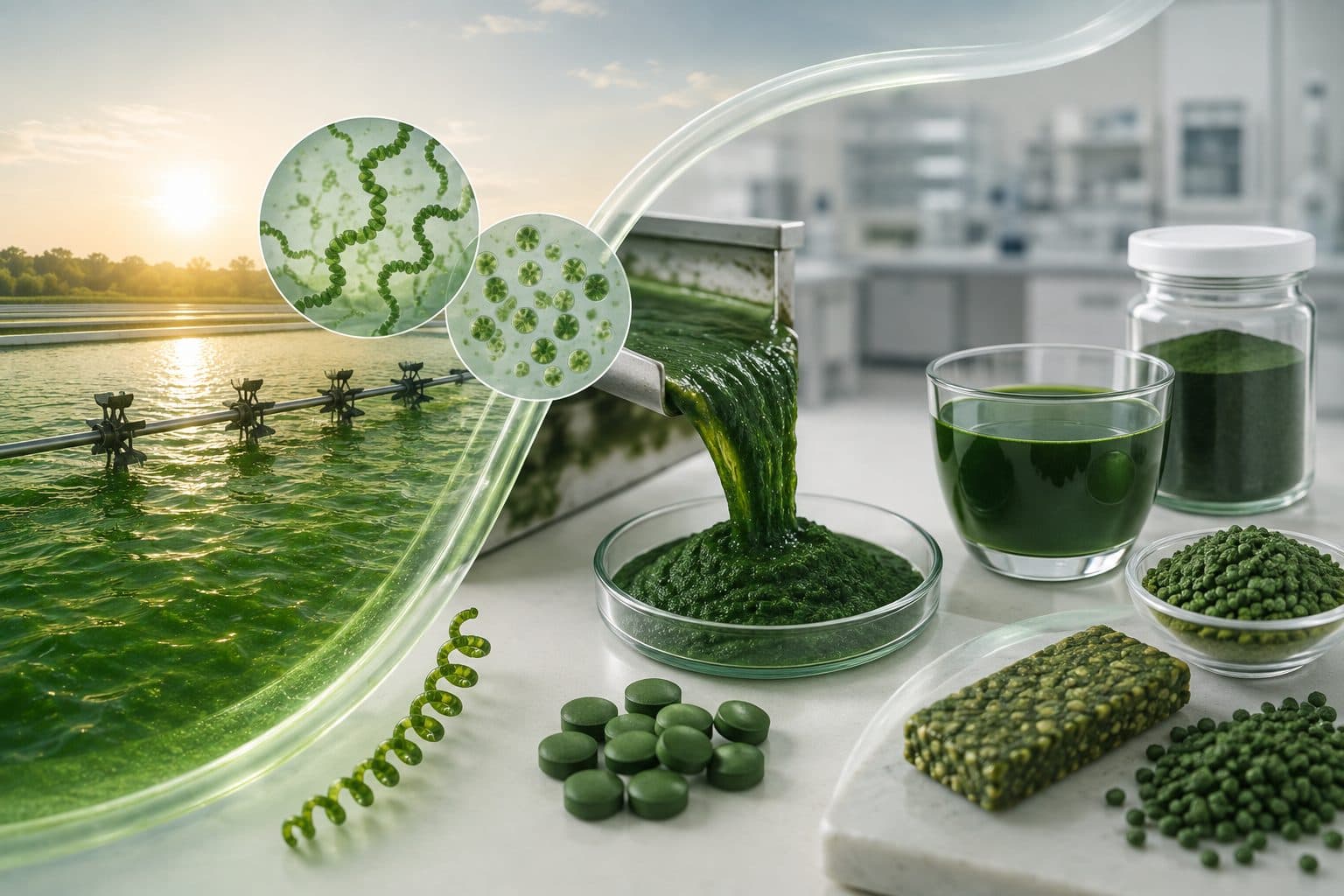
The journey from freshly harvested spirulina to a stable commercial ingredient involves several important processing stages. Among them, drying plays a particularly important role.
Fresh spirulina biomass contains a high amount of moisture. Drying reduces this moisture and transforms the harvested biomass into a more stable ingredient suitable for storage, transportation and further manufacturing. But drying is not simply about removing water.
The conditions used during drying — including temperature, exposure time and overall process control — can influence the physical and nutritional characteristics of the finished spirulina ingredient.
- Drying transforms freshly harvested spirulina into a more stable commercial ingredient.
- Drying influences more than moisture and may affect colour, pigments, aroma and physical characteristics.
- Temperature is important, but drying time and overall process conditions matter as well.
- Different drying technologies operate using different principles and processing conditions.
- Lower-temperature approaches aim to limit unnecessary thermal exposure.
- Refractance Window Drying is one technology designed for controlled drying of heat-sensitive materials.
- The drying technology should always be considered alongside process control and finished-product verification.
Why Does Spirulina Need to Be Dried?
After harvesting and dewatering, spirulina still contains significant moisture. Reducing this moisture is necessary to create a stable dried ingredient suitable for commercial use. Effective drying helps:
- Improve storage stability
- Reduce residual moisture
- Support consistent handling
- Prepare spirulina for further processing
- Enable commercial storage and transportation
The objective, however, is not simply to dry the biomass as quickly as possible. The drying process should achieve the required moisture reduction while managing the exposure of the ingredient to processing conditions.
Drying Is More Than Moisture Removal
It is easy to think of drying as a simple transition from wet biomass to dry powder. In practice, much more is happening.
Spirulina naturally contains proteins and pigments such as C-phycocyanin, chlorophyll and carotenoids. Its distinctive colour, aroma and physical characteristics are also part of the finished ingredient profile, and processing conditions can influence these characteristics.
This means drying needs to balance two objectives: achieving stability while helping preserve ingredient integrity. That balance is one of the reasons drying technology deserves careful consideration in spirulina production.
Temperature Matters
Temperature is an important consideration during spirulina drying. Exposure to elevated temperatures can influence heat-sensitive components and may affect characteristics such as natural pigments, colour and overall ingredient quality.
But temperature should not be considered alone. The impact of drying also depends on factors such as:
- Duration of exposure
- Moisture removal rate
- Airflow
- Product thickness
- Drying-system design
- Overall process control
For this reason, evaluating drying technology based only on a stated temperature provides an incomplete picture. The complete drying environment matters.
Why Drying Time Matters Too
Two drying systems operating at different temperatures may expose spirulina to very different processing conditions.
A lower temperature does not automatically mean a better outcome if the ingredient remains exposed for an unnecessarily long period. Likewise, efficient moisture removal requires careful control to avoid excessive processing.
This is why modern drying approaches increasingly focus on the relationship between temperature, time and moisture transfer, rather than temperature alone. For ingredient manufacturers, the objective is to achieve the required stability efficiently while limiting unnecessary exposure of the biomass to processing stress.
What Can Drying Influence?
Drying conditions may influence several characteristics of a finished spirulina ingredient.
- Natural Colour
- Spirulina's characteristic blue-green appearance comes largely from its naturally occurring pigments. Processing conditions can influence the appearance and intensity of this colour.
- Natural Pigments
- C-phycocyanin, chlorophyll and carotenoids contribute to spirulina's distinctive composition. Careful processing is important when the objective is to retain the characteristics established during cultivation.
- Aroma
- Drying conditions may also influence the characteristic aroma of spirulina. Appropriate processing helps manufacturers achieve a more consistent sensory profile between production batches.
- Moisture
- The final moisture level is an important specification for dried spirulina because it influences stability, storage and handling.
- Physical Characteristics
- Drying can affect texture, particle behaviour and the way the dried material performs during subsequent milling or formulation.
Together, these factors demonstrate why drying should be viewed as an important quality-influencing stage rather than simply a moisture-removal step.
Not All Drying Technologies Work the Same Way
Different drying technologies remove moisture using different combinations of heat, airflow, contact surfaces, pressure and drying time. Common approaches used across food and ingredient manufacturing may include:
- Spray drying
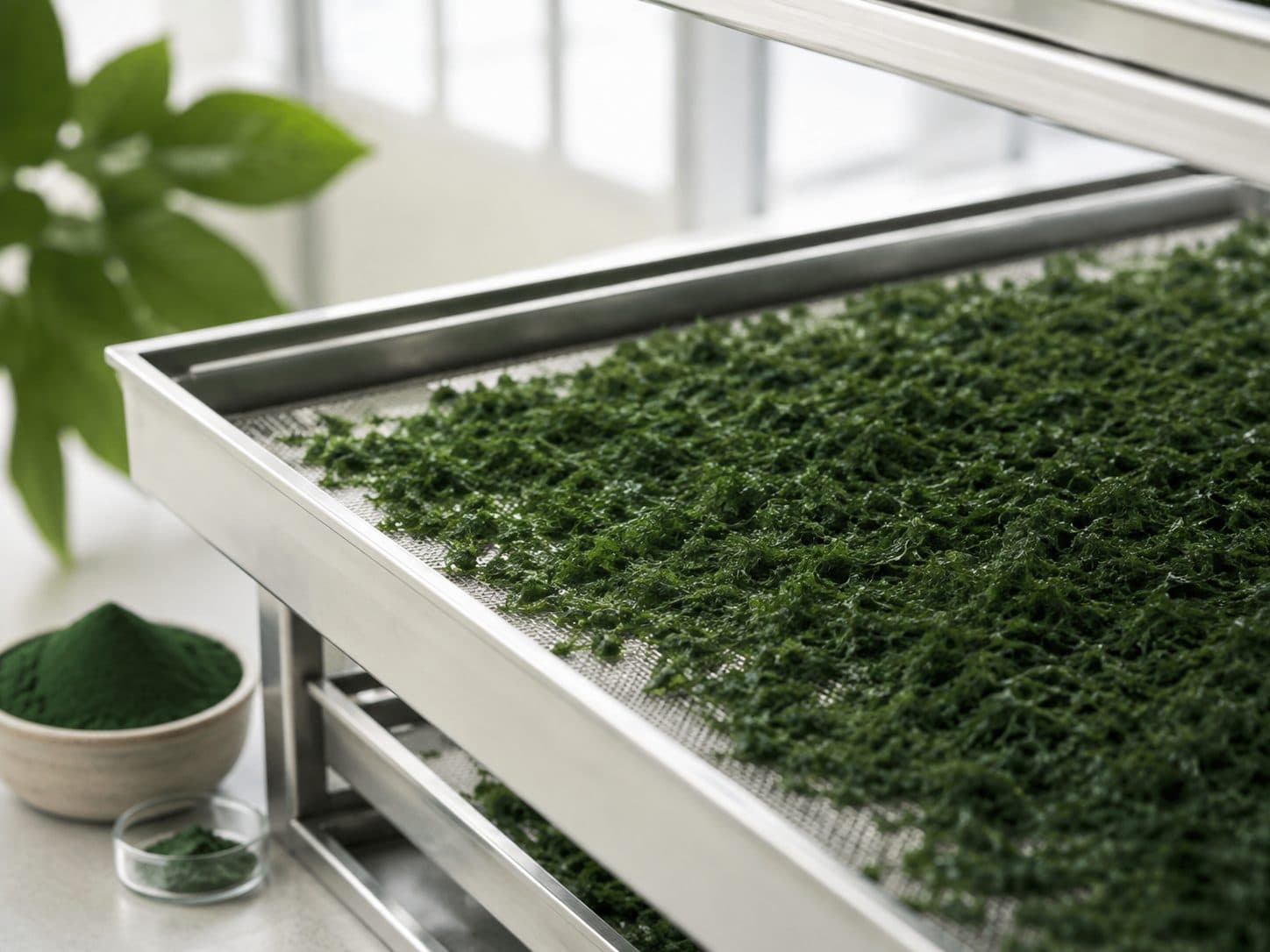
- Tray or hot-air drying
- Freeze drying
- Vacuum drying
- Refractance Window Drying
Each technology has its own processing characteristics, operational requirements and potential advantages. The appropriate method depends on factors such as the nature of the ingredient, production scale, desired finished-product characteristics and manufacturing objectives.
For spirulina, the important question is therefore not simply which drying technology is used, but how the drying process is controlled to achieve the desired ingredient characteristics.
The Growing Role of Low-Temperature Drying
As ingredient manufacturers place greater emphasis on preserving naturally occurring characteristics, lower-temperature drying technologies have attracted increasing attention. The principle is straightforward: reducing unnecessary thermal exposure may help maintain characteristics that could otherwise be affected by harsher processing conditions.
However, low-temperature drying should not be viewed as a quality guarantee on its own. A well-designed drying system still requires:
- Controlled operating parameters
- Consistent biomass preparation
- Appropriate drying time
- Defined moisture targets
- Finished-product verification
Technology is most effective when it forms part of a disciplined manufacturing system.
Where Refractance Window Drying Fits In
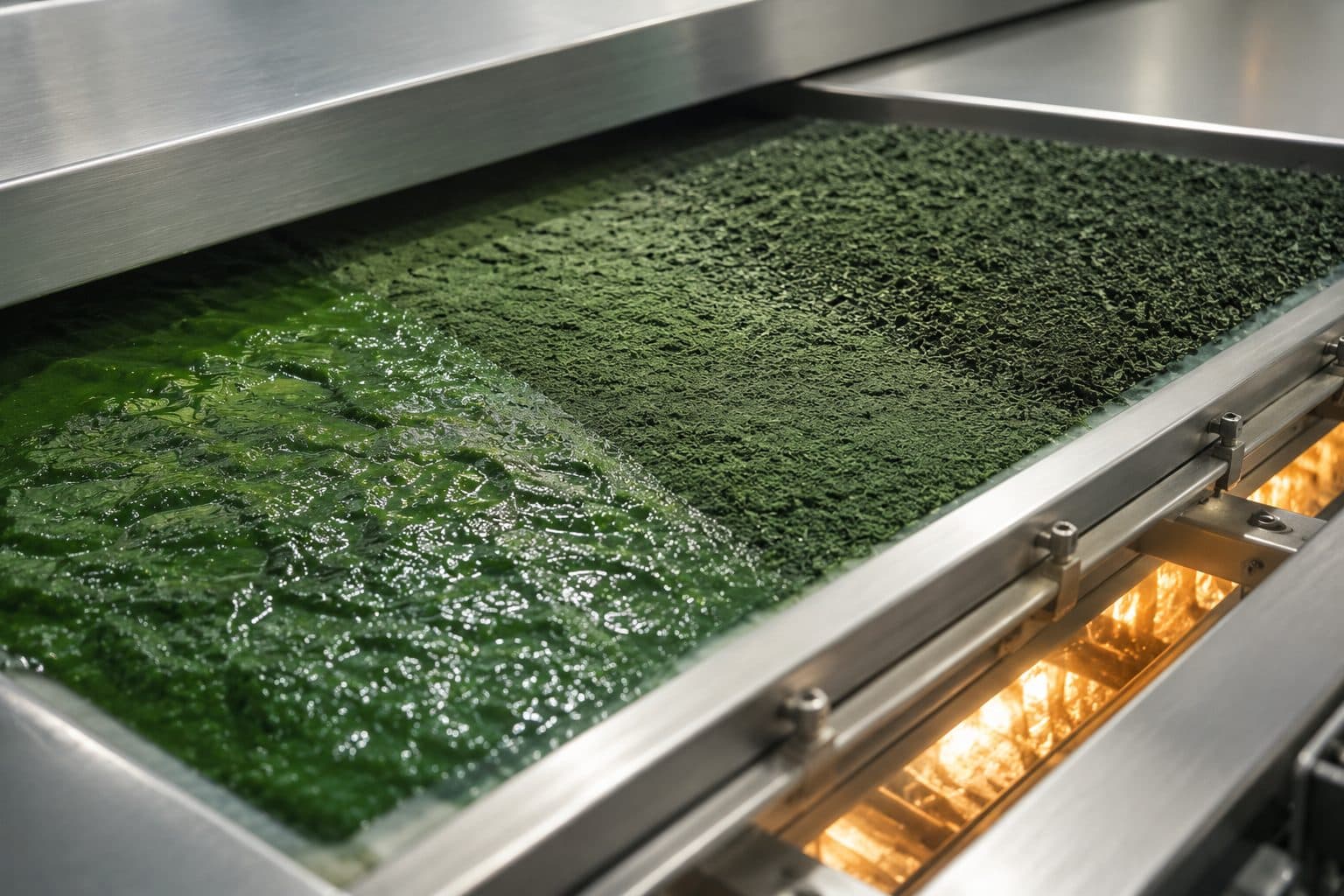
Refractance Window Drying (RWD) is one approach used for drying heat-sensitive food and biological materials. The technology is designed to transfer heat efficiently while limiting unnecessary thermal exposure of the material being dried.
For spirulina, this makes RWD particularly interesting where the objective is to reduce moisture while helping preserve naturally occurring characteristics such as pigments, colour and aroma.
Rather than viewing RWD simply as an alternative drying machine, it is more useful to understand it as part of a broader shift toward carefully controlled processing technologies designed around ingredient integrity. The effectiveness of any drying technology, however, ultimately depends on how it is implemented and controlled within the overall manufacturing process.
What Should Ingredient Buyers Ask?
Drying technology can provide useful information about a supplier's processing philosophy. When evaluating spirulina, buyers may consider asking:
- Which drying technology is used?
- How are drying conditions controlled?
- How is final moisture verified?
- How is batch-to-batch consistency monitored?
- Are relevant ingredient characteristics evaluated after drying?
- How does the supplier verify that the finished ingredient meets specification?
These questions provide more meaningful information than simply asking whether a supplier uses low-temperature drying.
Looking Beyond the Technology Name
No drying technology should be evaluated based solely on its name. The final ingredient reflects the combination of technology, process control and verification.
A sophisticated drying system without appropriate process control cannot independently guarantee ingredient quality. Similarly, the effectiveness of processing should ultimately be demonstrated through the characteristics and analytical results of the finished ingredient.
Conclusion
Drying is one of the most important transitions in spirulina production: the point at which freshly harvested biomass becomes a stable commercial ingredient. The technology selected — and the way it is controlled — can influence moisture, colour, pigments, aroma and other characteristics of the finished spirulina.
For manufacturers and ingredient buyers, understanding drying therefore provides another layer of insight when evaluating spirulina beyond nutritional specifications alone. The question is not simply how spirulina is dried, but how carefully the drying process is designed and controlled to protect the characteristics of the ingredient.
Why can't freshly harvested spirulina simply be stored as it is?
Fresh spirulina biomass contains significant moisture. Drying reduces moisture and helps create a more stable ingredient suitable for commercial storage, transportation and further processing.
Does higher drying temperature always mean lower-quality spirulina?
Not necessarily. Temperature is only one part of the drying process. Exposure time, moisture-transfer efficiency, airflow and overall process control also influence the final ingredient.
Why are spirulina pigments relevant when discussing drying?
Spirulina naturally contains pigments including C-phycocyanin, chlorophyll and carotenoids. Processing conditions can influence these naturally occurring characteristics, making drying an important consideration.
What is Refractance Window Drying?
Refractance Window Drying is a drying technology designed to transfer heat efficiently while limiting unnecessary thermal exposure of the material being dried.
Is low-temperature drying enough to guarantee premium spirulina?
No. Drying technology is only one part of ingredient quality. Cultivation, harvesting, processing control, testing and finished-product specifications all contribute to the final ingredient.