From Microalgae to Modern Ingredient
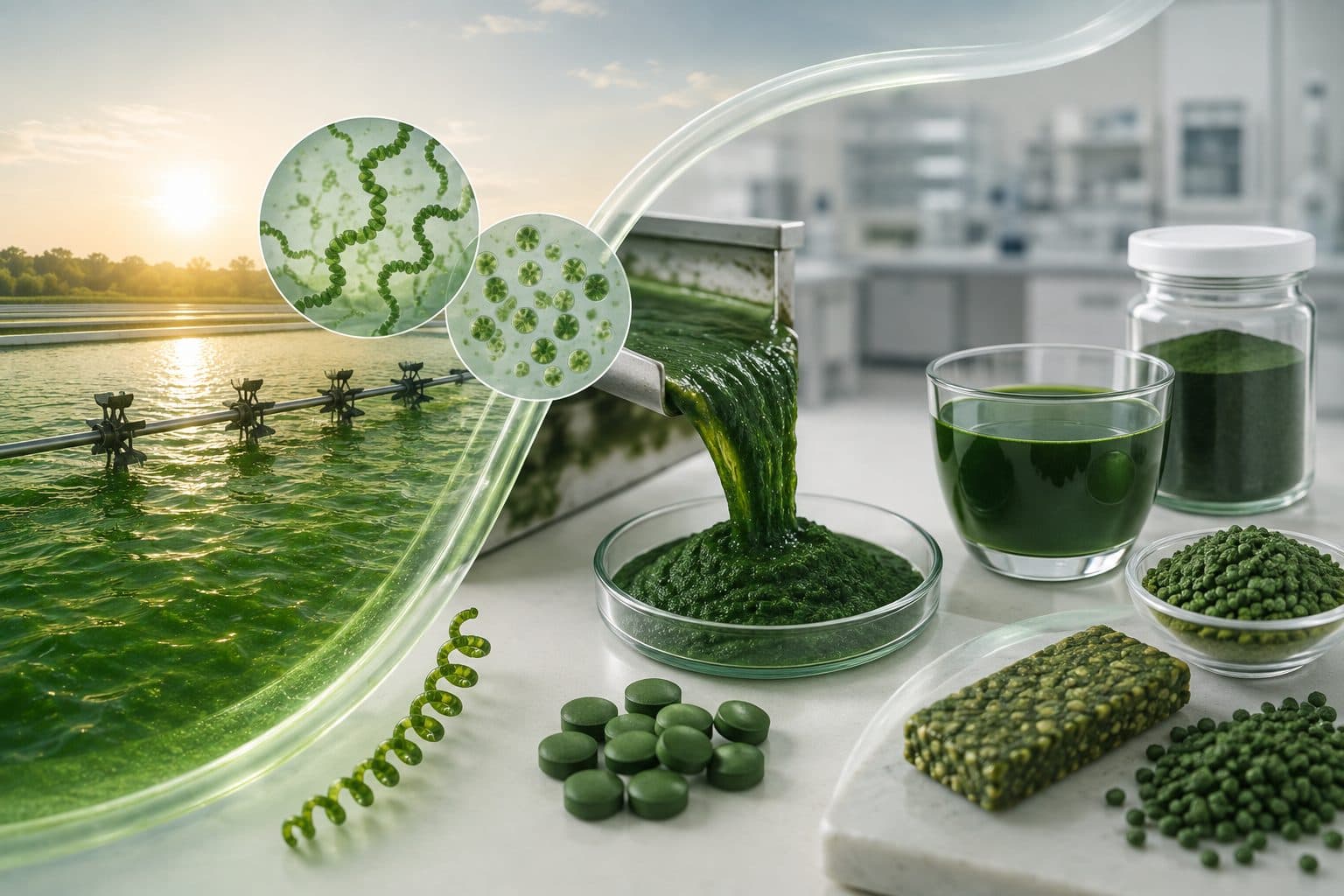
A finished spirulina powder looks simple. Behind it is a surprisingly complex journey.
The ingredient begins as a microscopic living organism growing within water. It then needs to be cultivated, harvested, separated, concentrated, dried, processed, evaluated and packaged before it becomes suitable for commercial ingredient supply.
That transformation is what turns biology into manufacturing.
- Spirulina begins as a living aquatic culture rather than a finished powder.
- Cultivation establishes the biomass and its biological characteristics.
- Harvesting and dewatering prepare the biomass for downstream processing.
- Drying creates the transition to a more stable ingredient.
- Particle control helps create a usable commercial format.
- Specifications and testing establish whether the batch meets defined requirements.
- Documentation gives the ingredient technical identity.
- Packaging and storage protect the finished material.
- Traceability connects the stages into one documented ingredient journey.
- Modern spirulina manufacturing is the combination of biology, engineering and quality systems.
It Begins With a Living Culture
Before there is powder, there is spirulina biomass. A carefully maintained culture forms the biological starting point.
At this stage, the priority is growth and culture health — not manufacturing a finished ingredient.
Cultivation Builds the Biomass
The organism grows under suitable environmental conditions. Sunlight supports photosynthesis, water provides the cultivation environment, nutrients support biomass development and circulation helps maintain a more uniform growing system.
During this stage, the characteristics of the future ingredient begin to develop.
Harvest Timing Connects Biology With Manufacturing
At some point, the culture reaches a stage appropriate for harvesting. This is where cultivation begins transitioning into processing.
The goal is to collect biomass efficiently while maintaining suitable conditions for downstream handling.
Harvesting Separates Biomass From the Cultivation System
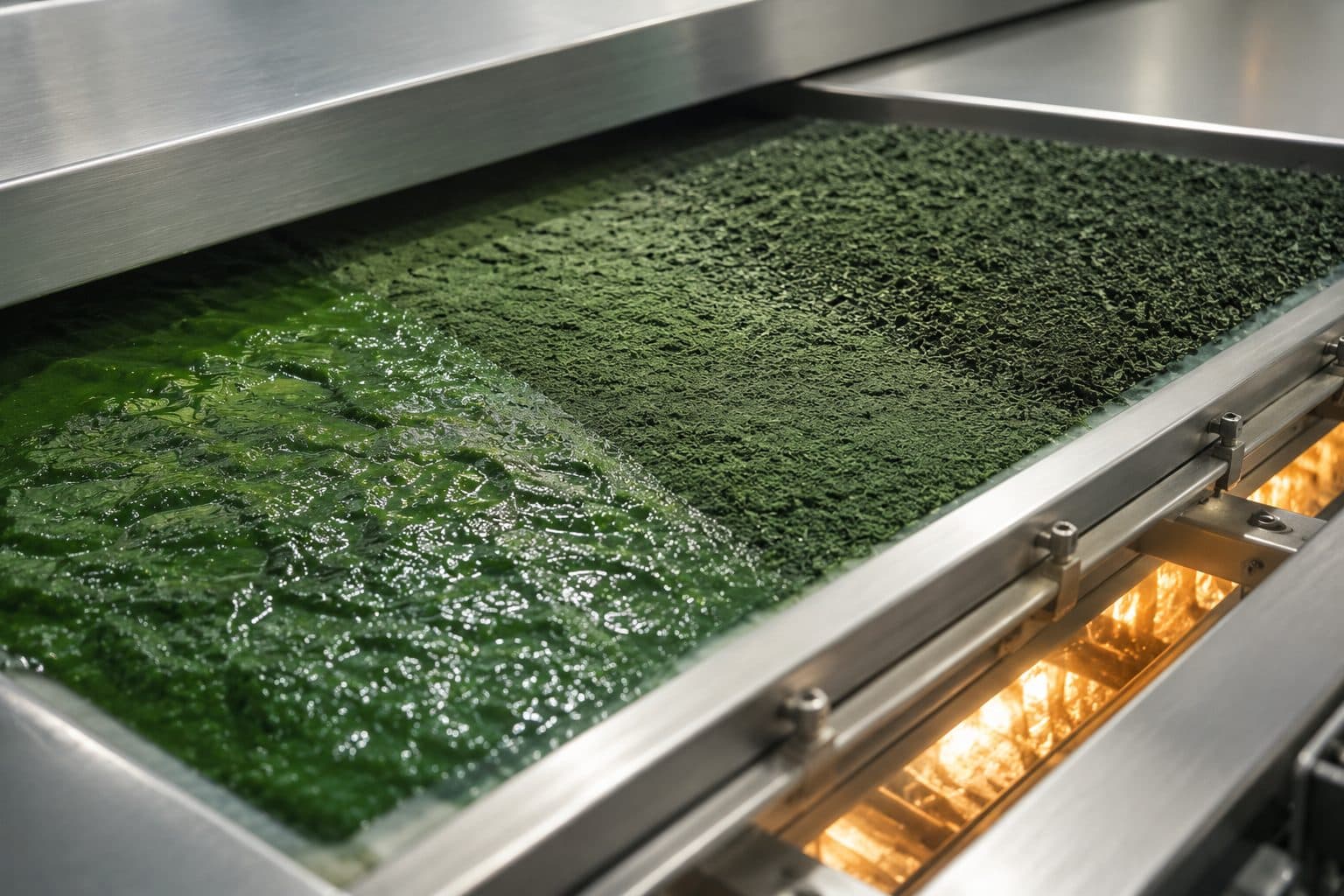
Fresh spirulina exists at relatively low concentration within the cultivation medium. Harvesting begins the process of separating that biomass from water, producing a much more concentrated material than the original pond culture.
Dewatering Removes More Moisture
Harvested biomass remains extremely wet. Further dewatering reduces the amount of water that must ultimately be removed during drying. This step can influence:
- Processing efficiency
- Energy requirement
- Material handling
- Drying performance
Efficient dewatering therefore becomes an important bridge between cultivation and drying.
Drying Creates Stability
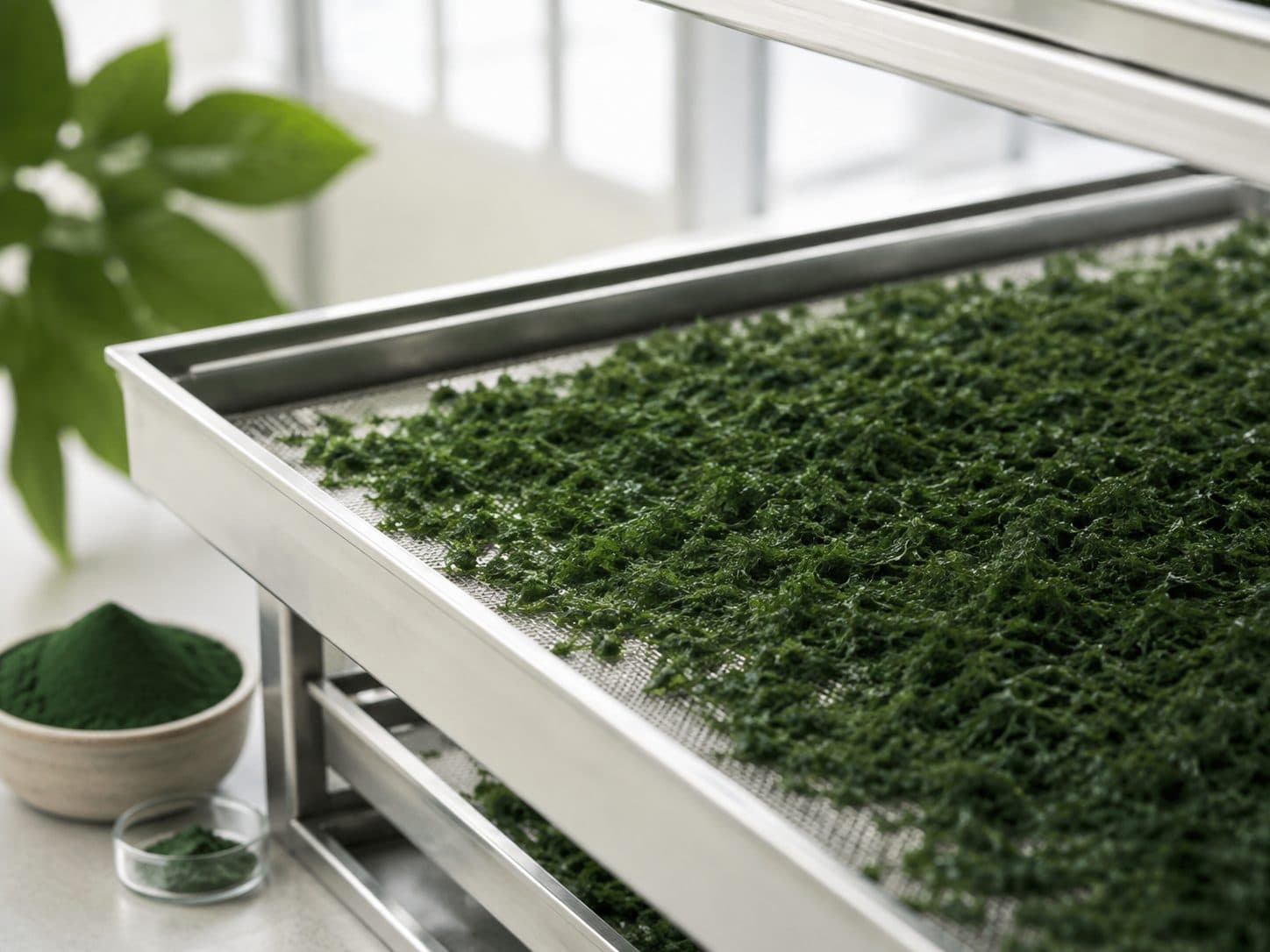
Fresh biomass is not yet a practical commercial dry ingredient. Drying removes moisture and transforms the harvested biomass into a more stable form — one of the most important transitions in the entire process. Drying conditions can influence:
- Moisture
- Colour
- Pigments
- Aroma
- Physical characteristics
The objective is therefore not simply to make spirulina dry. It is to create the required stability while managing ingredient integrity.
Particle Development Creates the Commercial Format
Once dried, the material may undergo further processing to create the required physical format. Depending on the product, this can involve:
- Milling
- Sieving
- Particle-size control
- Blending
- Granulation or agglomeration where appropriate
This is where the ingredient begins to take the form manufacturers actually purchase and handle.
Testing Turns Production Into Verification
An ingredient is not commercially ready simply because the production process is complete. The batch still needs to be evaluated. Relevant testing may include defined:
- Analytical parameters
- Microbiological parameters
- Heavy metals
- Moisture
- Identity
- Physical characteristics
Testing asks a simple but essential question: did the finished batch meet its established requirements?
Specifications Turn Natural Biomass Into a Defined Ingredient
Spirulina is biological. Commercial manufacturing requires predictability. A product specification creates the bridge between these two realities.
Rather than promising that nature will produce absolute sameness, the specification defines the characteristics within which the commercial ingredient is expected to perform.
This is what allows manufacturers to source spirulina as a controlled raw material.
Documentation Gives the Ingredient an Identity
A finished commercial batch exists not only physically but also through its documentation. This may include:
- Product specification
- Batch identification
- Certificate of Analysis
- Technical information
- Relevant declarations
- Supporting certifications
The documentation allows the customer’s procurement, quality and technical teams to understand what is being supplied.
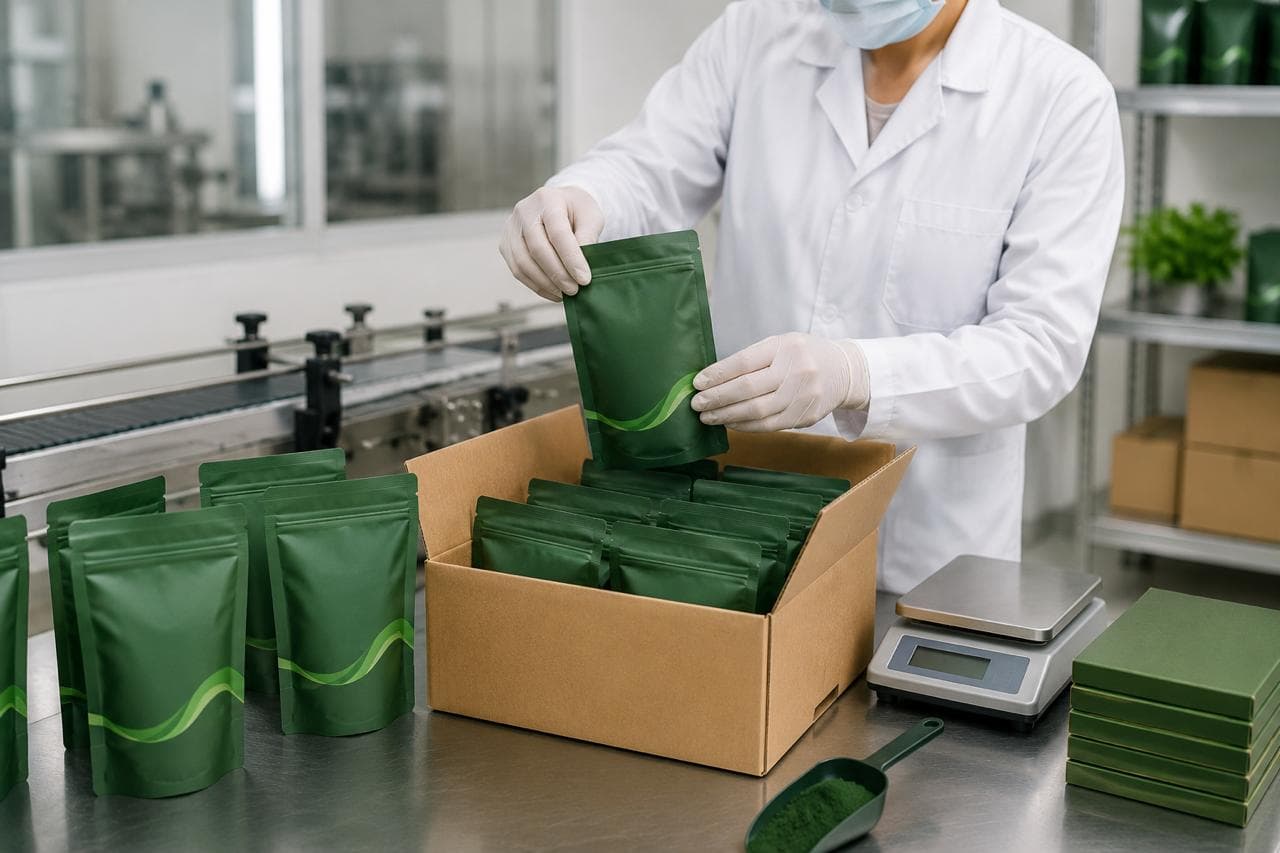
Packaging Protects the Finished Ingredient
Once production and verification are complete, the objective changes. The ingredient has been created; now it needs to be protected. Packaging helps manage exposure to environmental factors such as:
- Moisture
- Oxygen
- Light
- Handling
- Physical contamination
Appropriate storage continues that protection until the ingredient enters customer production.
Traceability Connects Everything
The strongest manufacturing system links the stages rather than treating them as isolated activities. The finished batch should be connected with relevant information from its journey, creating a chain:
- Cultivation
- Harvest
- Processing
- Testing
- Release
- Packaging
- Dispatch
This is what transforms production records into traceability.
Manufacturing Does Not Replace Biology
It is important to recognise the different jobs of cultivation and processing. Processing cannot create the biological composition that never developed during cultivation. Similarly, cultivation alone cannot create a stable commercial ingredient.
Both matter. Biology creates the biomass, engineering transforms it and quality systems verify it.
Why Integration Matters
When cultivation, processing and quality systems are closely connected, manufacturers can potentially gain greater visibility across the ingredient journey. Decisions made during one stage can be understood in relation to what happens next. This can support:
- Faster handling of fresh biomass
- Better production coordination
- Stronger batch records
- More consistent processing
- Clearer accountability
Integration is therefore as much about information and control as physical proximity.
The Finished Powder Is Only the Final Frame
A customer opening a package sees the final result. They do not see the cultivation parameters, the pond circulation, the harvest, the dewatering, the drying conditions, the testing, the records or the release decision.
Yet all of those stages contribute to the finished ingredient. That is what makes professional spirulina manufacturing much more than simply growing algae.
From Biology to Ingredient
The transformation can be summarised simply:
- Living culture
- Controlled biomass
- Harvested biomass
- Concentrated biomass
- Dried material
- Defined ingredient
- Verified batch
- Commercial supply
Every stage changes the material — or the information surrounding it — until something biological becomes something manufacturers can reliably work with.
Conclusion
There is something remarkable about the journey of spirulina. It begins as a microscopic organism using sunlight to grow in water. It ends as a precisely specified ingredient travelling through global manufacturing supply chains.
Between those two points is an entire system of biology, engineering, processing, analytical verification and documentation.
Understanding that journey changes the way we look at spirulina. It is no longer simply green powder. It is biology transformed into a modern ingredient.
What turns harvested spirulina into a commercial ingredient?
Dewatering, drying and particle processing create the physical format, while specifications, testing and documentation establish that the batch meets its defined requirements.
Why does a specification matter for a natural ingredient?
Spirulina is biological, so absolute sameness is not realistic. A specification defines the range within which the commercial ingredient is expected to perform, which is what allows it to be sourced as a controlled raw material.