How Packaging & Storage Protect Spirulina Quality
Producing a high-quality spirulina ingredient is only part of the journey. Once cultivation, harvesting, drying and quality verification are complete, the finished ingredient still needs to maintain its characteristics through storage, transportation and eventual use by the manufacturer.
Spirulina is a naturally derived ingredient containing pigments and other components that can be influenced by environmental conditions over time. The role of packaging is therefore much more than simply containing the powder — it creates a protective environment around the finished ingredient.
- Ingredient quality needs to be protected after production and batch release.
- Moisture, oxygen, light and temperature can influence spirulina during storage.
- Packaging should be viewed as a protective barrier system rather than simply a container.
- Packaging material, seal integrity and handling practices all contribute to protection.
- Bulk B2B packs create different handling requirements from consumer packaging.
- Opening a package changes the ingredient's exposure to the surrounding environment.
- Storage requirements need to be maintained throughout transportation and warehousing.
- Packaging does not create ingredient quality — it helps preserve it.
Quality Doesn't Stop at Batch Release
A batch may meet every required specification when it leaves production. But commercial ingredients are rarely used immediately. They may spend time in the manufacturer's warehouse, during transportation, at a distributor or importer's facility, in the customer's raw-material warehouse, and after a bulk pack has been opened.
During this period, the ingredient continues to interact with its surrounding environment. Good storage and packaging practices help minimise unnecessary exposure and support the characteristics established during production.
Moisture Is One of the Most Important Considerations
Spirulina powder is a dried biological ingredient. Once drying has reduced its moisture to the required level, the objective is to avoid unnecessary moisture uptake during subsequent storage and handling. Exposure to humid environments can influence:
- Powder flow
- Caking
- Texture
- Physical appearance
- Storage stability
Moisture control therefore begins with the packaging system and continues through warehousing and customer handling. A package that is repeatedly opened in a humid environment experiences different conditions from an unopened commercial pack.
Oxygen, Light and Temperature
Once an ingredient is packaged, the amount of oxygen to which it is exposed can depend on packaging material, closure, headspace, frequency of opening, storage duration and handling practices. Spirulina naturally contains components that may be susceptible to oxidative change over time, so limiting unnecessary exposure can form part of a broader protection strategy.
Spirulina's colour comes from naturally occurring pigments including C-phycocyanin, chlorophyll and carotenoids, and pigments can be sensitive to light. Research on stored spirulina powder has shown that the stability of C-phycocyanin can change during storage, reinforcing why storage conditions matter when pigment characteristics are important.
Temperature remains relevant after manufacturing too. Storage at unsuitable or fluctuating temperatures may influence the rate at which quality characteristics change over time, which is why suppliers define recommended storage conditions for commercial ingredients.
Packaging Is a Barrier System
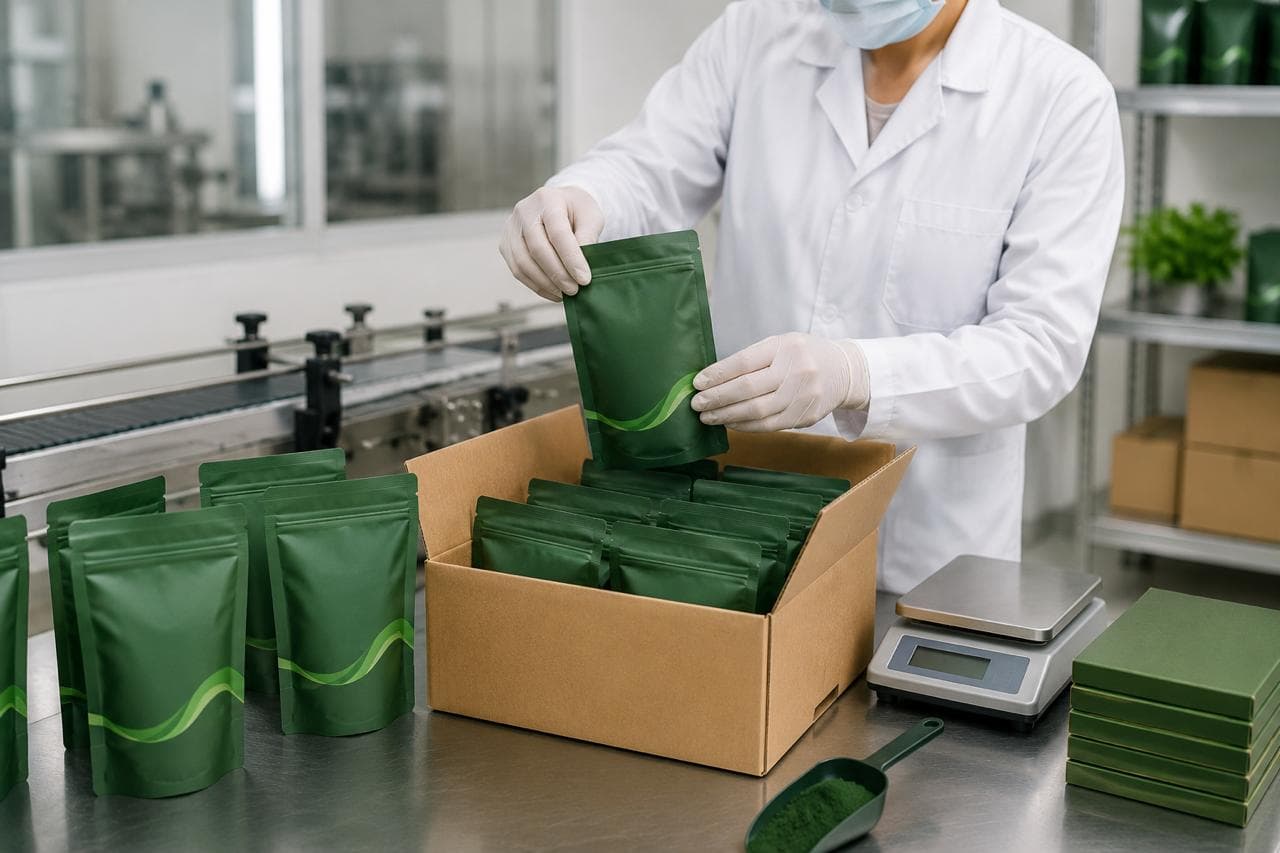
Bulk ingredient packaging should be thought of as a barrier between the spirulina and its environment, designed to provide protection from moisture, oxygen, light, physical contamination and damage during handling. Different packaging materials provide different barrier characteristics, and the appropriate system depends on:
- Ingredient format
- Pack size
- Intended shelf life
- Transportation conditions
- Destination market
- Storage environment
- Customer handling requirements
There is therefore no single packaging material that should automatically be considered ideal for every spirulina ingredient. The packaging needs to be appropriate for the product it is protecting.
Packaging Integrity Matters as Much as Packaging Material
A high-barrier material provides limited value if the package is not properly sealed. Packaging integrity therefore includes seal quality, closure integrity, resistance to damage, appropriate handling, correct storage and protection during transportation.
Even small failures can change the environment inside a pack. This is why packaging should be evaluated as a complete system rather than simply by the material printed on its specification — material, seal and handling conditions all work together.
Bulk Packaging Creates Different Requirements
B2B spirulina ingredients are often handled very differently from consumer products. A commercial pack may contain considerably more material and may be opened repeatedly during manufacturing, creating practical questions:
- How long will the pack remain open?
- Will the entire quantity be used at once?
- What humidity exists in the production environment?
- How will the remaining material be resealed?
- How will opened packs be identified?
- What storage conditions apply after opening?
These questions matter because the ingredient's exposure changes once the original package has been opened. Commercial manufacturers should therefore establish appropriate procedures for handling partially used ingredient packs.
Storage Conditions Need to Continue Through the Supply Chain
A supplier can package an ingredient correctly and still lose control of its environment once it leaves the manufacturing facility. Commercial supply may involve a warehouse, transport, a port or freight facility, an importer or distributor, the customer warehouse and finally the production floor — each introducing different environmental and handling conditions.
Clear storage instructions help communicate how the ingredient should be managed throughout this journey. This becomes particularly important for international supply, where transit periods may be longer and climatic conditions can vary considerably.
Packaging and storage should also not be considered independently. A packaging system designed for one storage environment may perform differently under another, so packaging selection should consider the real commercial journey of the ingredient.
What Should Manufacturers Monitor During Storage?
The relevant characteristics depend on the ingredient specification and stability programme. For spirulina, storage evaluation may consider:
- Moisture
- Water activity, where relevant
- Colour
- Pigment characteristics
- Aroma or other sensory characteristics
- Microbiological quality
- Packaging integrity
Research evaluating spirulina storage has examined parameters including moisture, water activity, phycocyanin and carotenoid stability under different packaging and temperature conditions. These observations help manufacturers understand whether the packaging and storage system is adequately protecting the ingredient.
Opening the Pack Changes the Environment
An unopened commercial package provides a controlled protective barrier. Opening it changes that environment immediately, exposing the ingredient to ambient humidity, oxygen, light, handling and production-room conditions.
This does not mean an opened pack becomes unsuitable. It means handling practices become more important. Manufacturers should follow established procedures relating to resealing, storage, identification and use of opened raw-material packs — particularly when a bulk pack is used across multiple production runs.
Packaging Should Support Traceability Too
Protection is the primary physical role of packaging, but commercial ingredient packs also carry important identification information. Appropriate labelling can communicate product identity, batch or lot number, net quantity, storage requirements, relevant dates and other required product information.
This allows the physical ingredient to remain connected with the information supporting it throughout warehousing and manufacturing. Packaging therefore contributes to both protection and identification.
Packaging Cannot Correct Poor Manufacturing
Packaging is important, but it should never be viewed as a way to compensate for an ingredient that was not produced appropriately. A protective package cannot create quality that was absent at production.
Instead, packaging has a different role. Cultivation establishes the biomass. Processing creates the stable ingredient. Testing verifies the batch. Packaging and storage help protect it afterwards. Each stage has its own purpose, and the strongest ingredient systems manage all of them together.
Conclusion
The journey of a spirulina ingredient does not end when manufacturing is complete. Between production and formulation, the ingredient may spend weeks or months being packaged, transported, stored and handled, and throughout that journey its surrounding environment matters.
Thoughtfully selected packaging and clearly defined storage conditions help protect the ingredient from unnecessary exposure to moisture, oxygen, light and unsuitable temperatures. For manufacturers, this makes packaging and storage part of ingredient quality — not an afterthought.
Why does spirulina need protective packaging?
Spirulina is a dried biological ingredient containing naturally occurring pigments and other components that can be influenced by environmental exposure. Appropriate packaging helps limit unnecessary exposure during storage and transportation.
What are the main environmental factors to consider?
Moisture, oxygen, light and temperature are important considerations when developing storage and packaging strategies for dried spirulina.
Should spirulina always be refrigerated?
Not necessarily. The correct storage conditions should be based on the specific product, packaging system and supplier's validated storage recommendations rather than a universal rule.
Does opening a bulk pack affect storage?
Opening the package exposes the ingredient to the surrounding environment. Appropriate handling, resealing and storage procedures should therefore be followed for partially used packs.
Does better packaging automatically mean a longer shelf life?
Not automatically. Packaging is one part of a complete stability system. Ingredient characteristics, processing, storage conditions and time also influence shelf life.