
Spirulina and the Future of Food
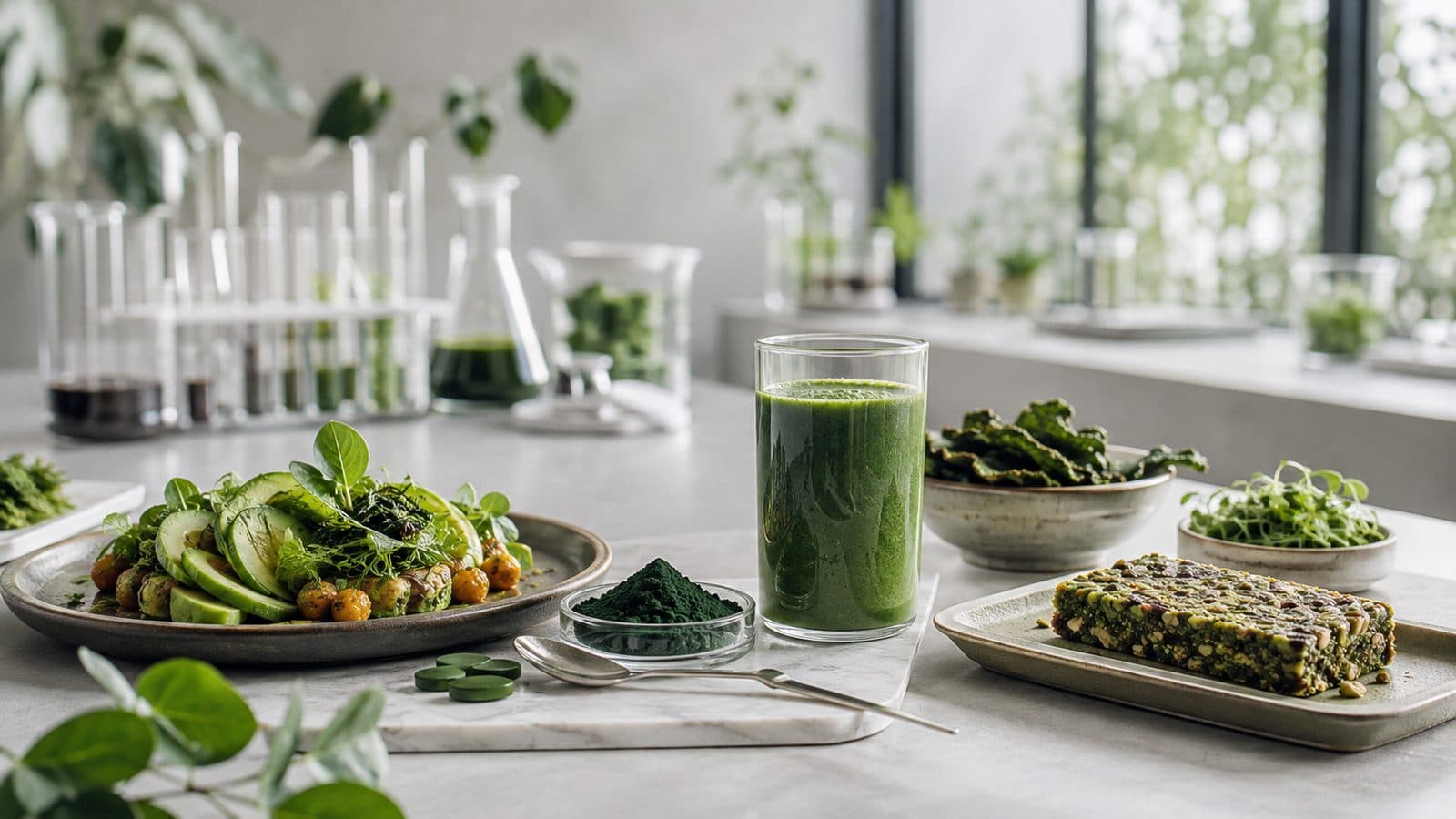
Food systems are changing. Consumers are looking for more from the foods they eat, manufacturers are exploring new sources of nutrition, and product developers are working with ingredients that can deliver nutritional value while fitting into increasingly diverse food formats.
Within this changing landscape, spirulina presents an interesting proposition. It is a microscopic photosynthetic organism that can be cultivated as a nutrient-rich biomass and transformed into a versatile commercial ingredient.
For decades, spirulina has largely been recognised as a supplement or “superfood.” Its future may be much broader.
- Spirulina is gradually moving beyond traditional supplement positioning.
- Its value extends beyond protein to naturally occurring pigments and other nutritional components.
- Functional foods may create new opportunities for spirulina incorporation.
- Future innovation will increasingly depend on application-specific ingredient formats.
- Taste and sensory performance will be critical to mainstream adoption.
- Processing technology will influence what spirulina ingredients can become.
- Spirulina does not need to replace conventional foods to play a meaningful role in future nutrition.
- Its long-term opportunity may be as a broader ingredient platform rather than simply a superfood.
From Supplement to Food Ingredient
Spirulina first became familiar to many consumers through tablets and green powders. That helped establish awareness of the ingredient, but it also created a narrow perception: spirulina equals supplement.
Today, product developers are exploring spirulina across a wider range of applications, from nutrition blends and functional foods to beverages and savoury formulations.
The shift is important. Rather than asking consumers to take spirulina separately, manufacturers can begin thinking about how spirulina might become part of foods people already consume.
Why Future Food Innovation Needs New Ingredients
The future of food will not be defined by one nutritional source. Instead, manufacturers will increasingly work with a broader portfolio of ingredients that bring different nutritional, sensory and functional characteristics.
Emerging ingredient development is being influenced by factors such as:
- Growing interest in plant-based nutrition
- Demand for nutrient-dense ingredients
- Functional food development
- Ingredient transparency
- Natural colours
- More efficient food-production technologies
- Greater attention to resource use
Spirulina sits at the intersection of several of these conversations.
Nutrition in a Small Biomass
One reason spirulina continues to attract interest is the nutritional complexity contained within the biomass. It naturally contains:
- Protein
- Amino acids
- C-phycocyanin
- Chlorophyll
- Carotenoids
- Minerals
- Vitamins and other naturally occurring components
Unlike a purified single nutrient, whole spirulina brings several components together within one ingredient. That complexity creates opportunities for manufacturers to look beyond a single nutritional claim.
Protein Is Only Part of the Story
Spirulina is frequently discussed because of its naturally high protein content. But treating it only as an alternative protein source overlooks much of what makes the ingredient interesting.
The biomass also contains naturally occurring pigments and other compounds that contribute to its colour, biological function and nutritional profile. This means spirulina can potentially participate in product development through several different roles:
- Nutrition
- Colour
- Ingredient identity
- Product differentiation
This broader perspective may become increasingly important as food innovation evolves.
Moving Beyond the “Green Powder” Format
One of the next stages of spirulina innovation will likely involve format development. Traditional spirulina powder is versatile, but different applications may benefit from ingredients designed around specific manufacturing requirements.
Future formats may increasingly focus on characteristics such as:
- Improved flow
- Easier dispersion
- Reduced dust
- Different particle sizes
- Application-specific functionality
- Pigment-rich fractions
Instead of expecting every manufacturer to work with the same green powder, ingredient development can become more application focused.
Functional Foods Create New Possibilities
Functional foods sit between everyday food and specialised nutrition. That creates an interesting environment for spirulina. Potential concepts can extend across:
- Savoury snacks
- Nutrition mixes
- Soups
- Pasta
- Baked products
- Functional beverages
- Protein foods
- Convenient nutrition formats
The strongest opportunities may not be products marketed primarily as “spirulina foods.” They may be products where spirulina quietly contributes to a broader nutritional concept.
Natural Colour Adds Another Dimension
Spirulina also enters the future-food conversation through its pigments. C-phycocyanin provides the distinctive blue component associated with spirulina, while chlorophyll contributes its characteristic green.
As manufacturers explore naturally derived colours, microalgae can become relevant not only because of nutrition but also because of visual functionality.
This gives spirulina a particularly interesting position: it can be considered as both a nutritional biomass and a source of naturally occurring pigments.
Better Processing Will Influence Future Products
Future spirulina ingredients will depend not only on cultivation but also on what happens afterwards. Dewatering, drying, milling, particle engineering and extraction can all influence the characteristics of the commercial ingredient.
As technologies improve, manufacturers may be able to create spirulina ingredients designed more precisely for specific applications.
This represents a shift from producing spirulina to engineering spirulina ingredients.
Taste Will Decide How Mainstream Spirulina Becomes
Nutrition can encourage trial. Taste drives repeat purchase.
One of the biggest challenges for whole spirulina in food applications is its characteristic flavour and aroma. Future product innovation therefore needs to focus not simply on how much spirulina can be added, but on how successfully it can be integrated into foods consumers genuinely enjoy. That may involve:
- Better ingredient processing
- Thoughtful flavour pairing
- Application-specific formats
- Lower inclusion levels used intelligently
- Improved formulation technology
The future of spirulina in food will ultimately be determined at least partly by consumer experience.
Spirulina Doesn’t Need to Replace Everything
Future-food conversations sometimes become overly focused on replacement, where one ingredient is presented as the replacement for another.
Spirulina does not need to replace conventional agriculture, proteins or food ingredients to become important. Its opportunity lies in complementing existing food systems.
The future may involve a much more diverse ingredient landscape where conventional crops, fermentation, microalgae and other technologies work alongside one another. Spirulina can occupy a distinctive place within that landscape.
Better Ingredients Need Better Manufacturing Systems
As spirulina enters increasingly sophisticated products, buyer expectations will rise. Manufacturers will require:
- Consistent specifications
- Reliable supply
- Appropriate documentation
- Traceability
- Quality verification
- Application understanding
- Predictable ingredient behaviour
The future of spirulina therefore depends not only on biological potential. It also depends on professional ingredient manufacturing.
From Superfood to Ingredient Platform
Perhaps the biggest opportunity is a change in perception. Spirulina became famous as a superfood. Its next chapter could be as an ingredient platform:
- Whole biomass
- Protein-rich ingredient
- Natural pigments
- Application-specific formats
- Functional food innovation
Different processing technologies can unlock different uses from the same biological starting point. That creates far more potential than the traditional jar of green powder.
Conclusion
Spirulina’s future is unlikely to be defined by the green powder that first made it famous. The greater opportunity lies in understanding the organism as a versatile source of nutrition, pigments and ingredient innovation.
As cultivation, processing and formulation technologies advance, spirulina may increasingly move from the supplement shelf into a much broader world of modern food development.
The future of spirulina is not simply about consuming more of it. It is about finding better ways to use it.
Is spirulina considered a future food?
Spirulina is increasingly discussed within future-food and alternative-nutrition conversations because of its nutritional composition and cultivation characteristics.
Will spirulina replace conventional protein sources?
That is unlikely to be the most useful way to view it. Spirulina can complement other nutritional ingredients rather than replacing all existing protein sources.
Can spirulina be used outside supplements?
Yes. Product developers can explore it across different food and beverage applications depending on formulation and regulatory requirements.