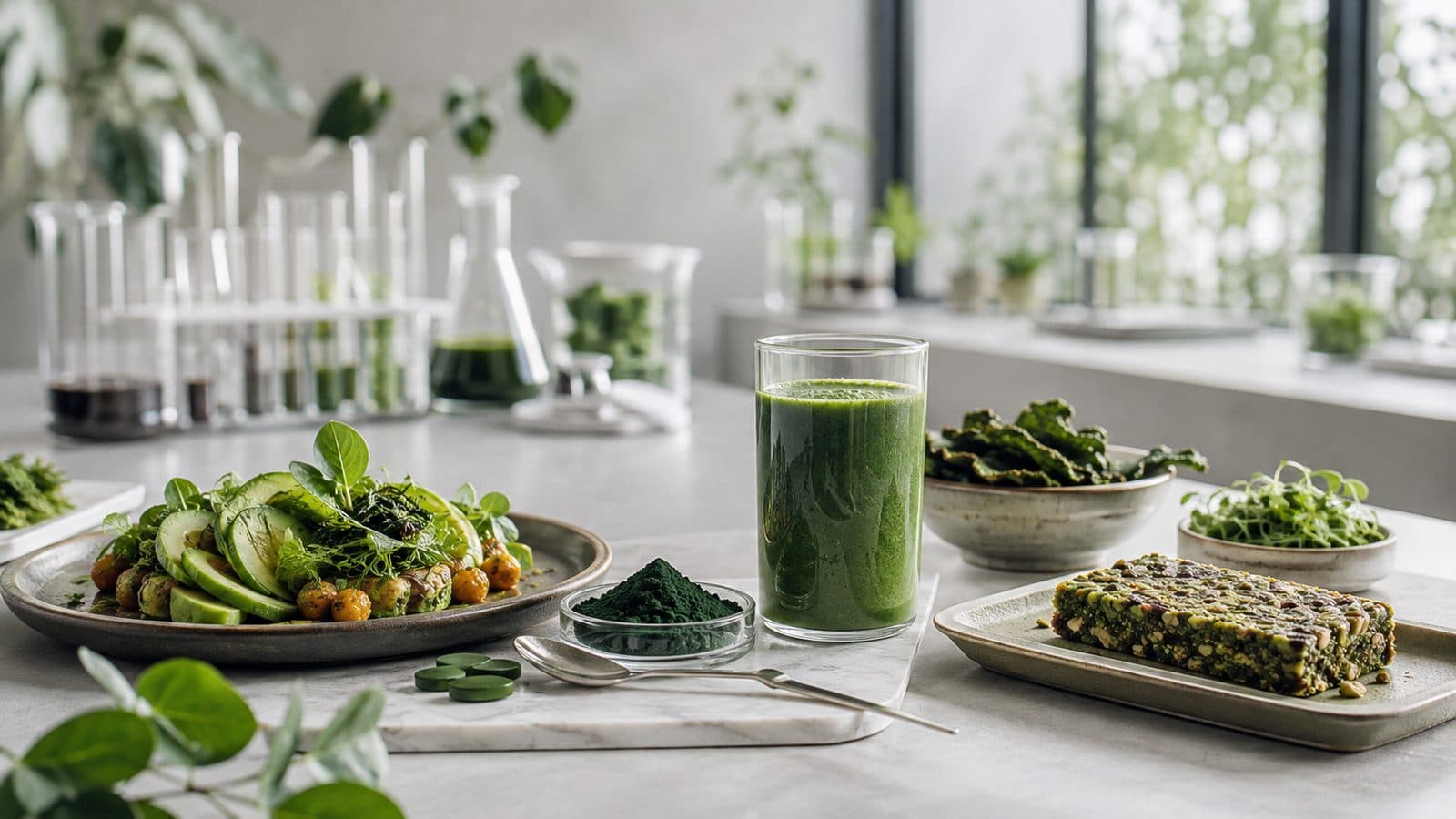
Global Trends Driving the Future of Spirulina

Spirulina has travelled an interesting path. Once primarily associated with traditional dietary supplements and green nutrition powders, it is increasingly being considered within a much broader ingredient landscape — one shaped by functional nutrition, plant-based product development, natural colour solutions, ingredient transparency and advances in food technology.
The future of spirulina will not be defined by one application or one consumer trend. It will be shaped by several changes happening simultaneously across nutrition, food science and ingredient manufacturing.
- Spirulina is expanding beyond traditional standalone supplement positioning.
- Functional nutrition and plant-based development are creating new formulation opportunities.
- Natural pigments are becoming an increasingly interesting part of spirulina innovation.
- Manufacturers are evaluating ingredients for performance and consistency as well as nutrition.
- Processing technology may become an important source of ingredient differentiation.
- Application-specific formats can improve commercial usability.
- Traceability, documentation and quality expectations are becoming increasingly important.
- Sustainability claims are likely to become more evidence-driven.
- Spirulina is evolving from a single superfood concept toward a broader ingredient platform.
Functional Nutrition and Plant-Based Innovation
Nutrition is increasingly moving beyond traditional supplement formats. Consumers encounter functional ingredients across everyday products — from nutrition mixes and snacks to beverages and specialised food concepts. This creates a broader environment for ingredients such as spirulina, which can be considered as part of larger formulation systems where nutrition, convenience and product experience come together.
Plant-based product development has likewise moved well beyond simply replacing animal-derived foods. Manufacturers are exploring naturally derived ingredients for their nutritional composition, functionality and ability to support differentiated product concepts. Spirulina's protein content, natural pigments and overall composition give formulators several characteristics to work with within one ingredient.
For manufacturers, this shifts the conversation from how to sell spirulina to what can be created with it.
Consumers Are Looking More Closely at Ingredient Lists
Ingredient transparency has become increasingly important across food and nutrition. Consumers are paying more attention to what ingredients are used, where they come from, how products are processed and why particular ingredients are included.
For manufacturers, however, transparency involves more than using recognisable ingredient names. The supply chain behind those ingredients also matters. As expectations evolve, ingredient suppliers may increasingly need to support manufacturers with clear specifications, documentation, traceability and information about how their ingredients are produced.
Natural Colour Is Creating New Opportunities
One of the most interesting aspects of spirulina is its natural pigment system. C-phycocyanin contributes its characteristic blue component, while chlorophyll and carotenoids contribute to its broader pigment profile.
As manufacturers continue exploring naturally derived colour solutions, spirulina and spirulina-derived pigments have attracted interest for their visual characteristics as well as their nutritional identity — particularly across naturally coloured foods, functional beverages, nutrition products and visually distinctive formulations.
For spirulina, colour is increasingly becoming part of the innovation story rather than simply a characteristic of the raw material.
Product Developers Are Asking More From Ingredients
The ingredient industry is gradually moving away from evaluating raw materials through one headline specification. Manufacturers increasingly consider the complete behaviour of an ingredient:
- Nutritional composition
- Physical characteristics
- Processing compatibility
- Stability
- Sensory impact
- Documentation
- Consistency
- Commercial supply capability
For spirulina suppliers, this means that producing nutritionally strong biomass alone may not be enough. The ingredient also needs to function within increasingly sophisticated manufacturing systems, so the future depends partly on understanding what happens after the ingredient leaves the supplier.
Processing Technology Is Becoming a Differentiator
As ingredient markets mature, processing technology can become an increasingly important point of differentiation. The question is no longer simply whether spirulina can be dried and converted into powder — manufacturers are increasingly interested in how processing conditions influence the characteristics of the finished ingredient.
This has created interest in technologies designed to manage thermal exposure, moisture removal, pigment preservation, colour, physical characteristics and manufacturing consistency. The objective is increasingly moving from simply producing dried spirulina toward producing spirulina with deliberately controlled ingredient characteristics.
Ingredient Formats Are Becoming More Application-Specific
Traditional spirulina has commonly been supplied as powder or finished tablets. As commercial applications become more diverse, manufacturers may increasingly require ingredient formats designed around particular processing needs, valuing characteristics such as:
- Fine particle size
- Improved flow
- Reduced dust
- Easier handling
- Improved dispersion
- Different bulk-density profiles
The future may increasingly involve spirulina designed for the manufacturing application, rather than expecting every manufacturer to adapt to the same ingredient format.
Consistency, Traceability and Quality Expectations
As spirulina moves into larger-scale commercial products, consistency becomes increasingly important. This places greater emphasis on controlled cultivation, defined manufacturing parameters, product specifications, batch verification and repeatable physical characteristics. In emerging categories novelty can attract attention; in established commercial supply, repeatability builds trust.
Modern ingredient supply chains are also becoming more transparent. Manufacturers increasingly want to understand where ingredients originate, how batches are identified and what documentation supports the material being supplied — creating a documented connection from source through production and testing to the finished ingredient.
Buyer expectations are becoming more sophisticated too. The conversation is moving beyond whether this is spirulina toward what specification it meets, how consistent it is, how it is processed, how each batch is verified and whether the supplier can support a given market. This evolution is healthy: higher expectations encourage stronger manufacturing systems, analytical verification and documentation.
B2B Buyers Are Looking for More Than Raw Material
Ingredient relationships are changing too. Manufacturers increasingly value suppliers capable of supporting the technical and operational requirements surrounding the ingredient — product information, samples, technical documentation, quality communication, regulatory support, commercial planning and consistent supply.
This does not mean ingredient suppliers need to become product-development companies. It means the value of a supplier increasingly includes the knowledge and support surrounding the ingredient, not simply the material itself.
Global Supply and Sustainability
As spirulina moves across international markets, suppliers increasingly need to understand different regulatory, quality and commercial expectations. An ingredient that works for one domestic application may require different specifications, documentation or certifications when supplied internationally, placing greater emphasis on market awareness, documentation, quality systems, packaging, logistics and regulatory readiness.
Interest in the environmental profile of nutritional ingredients also continues to influence product development. Spirulina's cultivation characteristics make it part of the broader conversation around alternative nutritional resources — but sustainability claims increasingly need to move beyond broad statements toward specific questions about resource use, water management, energy, production efficiency, waste, packaging and supply-chain practices.
From Superfood to Ingredient Platform
Perhaps the most important shift is conceptual. For years, spirulina has often been marketed primarily as a superfood. That description helped introduce the ingredient to consumers.
But from a B2B perspective, spirulina has the potential to become something broader: an ingredient platform. Protein. Natural pigments. Whole-biomass nutrition. Different physical formats. Multiple product-development possibilities.
This does not mean every component or application will become commercially relevant. It means manufacturers are increasingly able to look at spirulina through multiple lenses rather than treating it as one green powder for one type of product.
Conclusion
Spirulina's next chapter is likely to look very different from its first. The ingredient is moving beyond the familiar image of a green nutritional powder and entering a more sophisticated world of functional foods, natural pigments, ingredient technology and commercial product development.
At the same time, expectations are rising. Manufacturers want greater consistency. Buyers want greater transparency. Formulators want ingredients that work within real production systems. Global markets require stronger quality and documentation. The future is not simply about producing more spirulina — it is about creating better, more consistent and more useful spirulina ingredients for the products of tomorrow.
Is spirulina mainly a supplement ingredient?
Dietary supplements remain an important application, but spirulina is also being explored across functional foods, beverages and other ingredient applications.
Why are natural pigments important to spirulina's future?
Spirulina naturally contains pigments including C-phycocyanin, chlorophyll and carotenoids, creating opportunities where natural colour and ingredient identity are relevant to product development.
Will spirulina powder remain the main format?
Powder is highly versatile, but manufacturers may increasingly explore alternative physical formats where improved handling, flow or application-specific characteristics are useful.
Why will consistency become more important?
As spirulina enters larger-scale commercial manufacturing, brands need ingredients that perform predictably across repeated production batches.
What could differentiate spirulina suppliers in the future?
Manufacturing control, processing technology, ingredient consistency, documentation, application understanding and reliable commercial supply may all contribute to differentiation.