
Why Ingredient Consistency Matters in Commercial Manufacturing
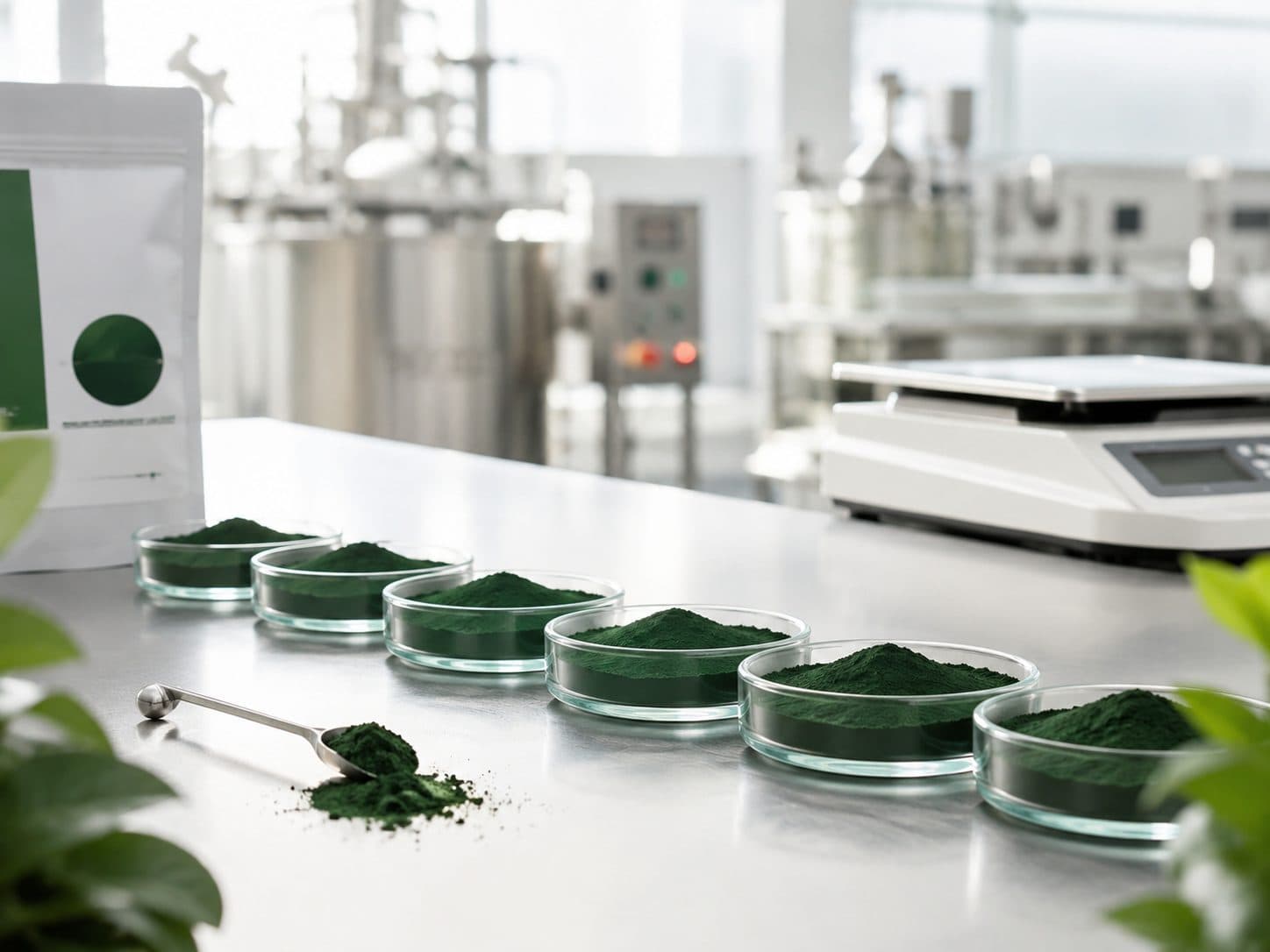
In commercial manufacturing, consistency is not simply a desirable ingredient characteristic. It is what allows a formulation developed today to behave predictably when it is manufactured again tomorrow, next month and at significantly larger scale.
Naturally derived ingredients such as spirulina are biological materials, and some degree of natural variation can exist. The objective of controlled ingredient manufacturing is therefore not to pretend that natural variability does not exist. It is to understand it, manage it and consistently deliver within defined specifications.
- Naturally derived ingredients can vary; commercial manufacturing manages that variability within defined specifications.
- Small differences at ingredient level can become more significant at commercial scale.
- Colour, moisture, particle characteristics and density can influence finished-product manufacturing.
- Predictable raw materials support formulation repeatability and scale-up.
- Ingredient consistency can reduce unnecessary reformulation, investigation and production adjustment.
- Specifications provide an objective framework for defining acceptable consistency.
- One successful batch demonstrates quality at one point in time; repeatability demonstrates reliability.
What Does Ingredient Consistency Actually Mean?
Consistency does not mean that every particle of a naturally derived ingredient is identical. In commercial ingredient supply, consistency means maintaining relevant characteristics within established and acceptable parameters from one production batch to another. Depending on the ingredient and application, these may include:
- Nutritional composition
- Moisture
- Colour
- Aroma
- Particle characteristics
- Bulk density
- Flow behaviour
- Microbiological specifications
A manufacturer can then design its product around a predictable ingredient range rather than an unpredictable raw material. That distinction becomes increasingly important as production scales.
Small Ingredient Variations Can Become Large Production Variations
At laboratory scale, small differences between ingredient batches may be relatively easy to accommodate. Commercial manufacturing is different. When kilograms of an ingredient are incorporated across thousands of finished units, variation can become much more visible.
A change in colour may influence an entire production batch. A difference in bulk density may influence filling behaviour. A change in moisture may affect powder handling. Different particle characteristics may influence blending. The larger the manufacturing operation becomes, the more important predictable ingredient behaviour can be.
Formulations Are Developed Around Expected Inputs
A commercial formulation is a controlled system. During product development, manufacturers establish ingredient quantities, processing sequence, mixing conditions, equipment settings, target product characteristics and finished-product specifications.
Those decisions are based partly on the expected behaviour of the raw materials. If an ingredient changes significantly from one batch to another, the assumptions built into the formulation may change with it, and manufacturers may need to adjust processing conditions or investigate why the finished product is behaving differently. Consistent raw materials help reduce this uncertainty.
Colour, Moisture and Particle Characteristics
Spirulina provides a particularly clear example because its colour is naturally distinctive. Its blue-green appearance can contribute visibly to tablets, capsules, powder blends, functional foods and beverages. If ingredient colour varies significantly between batches, the finished product may also appear different — so colour consistency is not merely cosmetic.
Moisture is another seemingly simple specification with broader implications. Differences in ingredient moisture may influence powder flow, caking, blending, compression behaviour, storage characteristics and interaction with other ingredients.
Two powders may also have similar nutritional composition but behave differently on manufacturing equipment. Particle size, distribution, density and flow characteristics can influence weighing, conveying, mixing, hopper flow, encapsulation, tablet manufacturing and filling operations. At small scale these differences may be manageable manually; at commercial scale, equipment needs materials to behave with greater predictability.
Blend Uniformity Depends on Predictable Ingredients
Many commercial products contain multiple ingredients. Achieving a uniform blend becomes more challenging when ingredients differ significantly in particle size, density or flow behaviour.
If the physical characteristics of one ingredient vary substantially between batches, the blending behaviour of the complete formulation may change — influencing mixing time, segregation risk, filling consistency and finished-product uniformity. Consistent ingredient characteristics therefore support more repeatable blending processes.
Consistency Supports Quality Control and Reduces Reformulation
When raw materials are predictable, quality teams have a clearer baseline from which to evaluate production. Significant ingredient variability can create additional investigations, increased sampling, additional testing, production adjustments and potential batch delays.
This does not mean natural ingredients must never vary. It means variability needs to remain understood and controlled within appropriate specifications. The more predictable the raw material, the easier it becomes to distinguish normal variation from something requiring investigation.
A formulation should also not need to be redesigned every time a new ingredient batch arrives. Repeated adjustments consume R&D time, manufacturing resources, quality resources, raw materials and production capacity — inefficiencies that accumulate quickly across multiple SKUs or large volumes.
Consistency Matters Even More During Scale-Up
A formulation that performs well during a small pilot run eventually needs to move into commercial production. Scale-up introduces larger equipment, longer processing times and greater quantities of raw material, and ingredient variability that was manageable during laboratory development may become more significant.
Predictable raw-material characteristics make it easier to understand whether changes observed during scale-up are caused by the ingredient or by the manufacturing process itself. That distinction can save considerable development time.
Consistency Has a Commercial Value
Ingredient purchasing decisions often focus on cost per kilogram. But inconsistency can create costs elsewhere:
- Additional quality testing
- Manufacturing downtime
- Reformulation work
- Increased wastage
- Delayed production
- Additional technical investigation
- Finished-product variation
This is why the lowest raw-material price does not always represent the lowest overall manufacturing cost. A predictable ingredient can create value by reducing uncertainty throughout the production system.
How Is Consistency Supported?
For naturally derived ingredients, consistency begins well before final testing. It may be supported through a combination of:
- Defined cultivation conditions
- Controlled processing parameters
- Standardised manufacturing procedures
- Established product specifications
- Analytical verification
- Batch-level records
- Appropriate storage and handling
No single control creates consistency on its own. It is the result of multiple controls working together throughout production. Specifications then define the acceptable range: consistency does not mean absolute sameness, it means reliable conformity within defined parameters.
Conclusion
Ingredient consistency is easy to underestimate because its greatest value is often seen in the problems that do not happen. A formulation does not need adjustment. A production line behaves as expected. The finished product maintains its familiar appearance. Production remains on schedule.
The goal with a naturally derived ingredient such as spirulina is not to eliminate biology or promise impossible uniformity. It is to manage natural variation through controlled production and defined specifications so manufacturers know what they can reasonably expect from one batch to the next. Because at commercial scale, consistency is about helping the customer's entire manufacturing system perform consistently too.
Does ingredient consistency mean every batch must be identical?
No. Natural ingredients can have some variation. Commercial consistency means maintaining relevant characteristics within defined and acceptable specifications.
Why does spirulina colour consistency matter?
Spirulina can contribute visibly to the colour of a finished formulation. Significant variation in the raw ingredient may therefore influence finished-product appearance.
Can particle size affect manufacturing?
Yes. Particle characteristics can influence powder flow, blending, filling, compression and other manufacturing operations.
How can manufacturers assess ingredient consistency?
Defined specifications, batch-specific analytical results, physical characteristics and performance across repeated commercial batches can all contribute to evaluating consistency.
Is consistency only a quality issue?
No. It can also affect R&D, manufacturing efficiency, production planning, finished-product appearance and overall commercial cost.